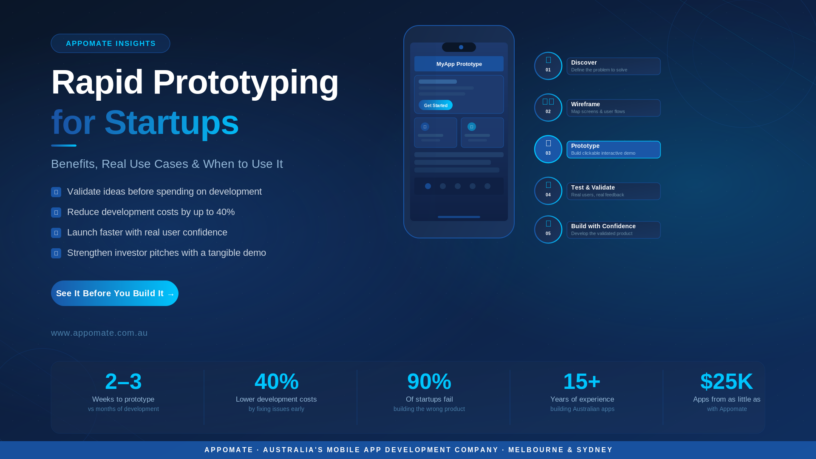
Most startups don’t fail because of bad technology. They fail because they build the wrong product. Rapid prototyping for startups directly solves this problem. Instead of spending months — and tens of thousands of dollars — building an app based on assumptions, you create a testable version of your idea first, gather real user feedback, and then build with confidence.
In Australia’s fast-moving startup landscape, speed and validation are no longer optional. Whether you’re building a marketplace app, a SaaS platform, a wellness solution, or a B2B tool, the ability to test your concept before committing to full development can be the difference between a successful launch and a costly mistake.
This guide covers everything Australian founders need to know about rapid prototyping — what it is, why it matters, the key benefits, real-world use cases, and how to use it to reach product-market fit faster.
What Is Rapid Prototyping for Startups?
Rapid prototyping is an iterative product development approach where you create early, testable versions of your app — before a single line of production code is written.
These prototypes can range from simple clickable wireframes to fully interactive mockups that simulate the real user experience. The goal is not to build something perfect. The goal is to learn fast. You test the concept, watch how users interact with it, collect feedback, and improve — all before committing significant budget to development.
At Appomate, we call this approach “See It Before You Build It.” Our Rapid App Prototyping method helps founders visualise their app in real time, validate technical feasibility, and get a clear, accurate estimate for what development will actually cost. This saves time, money, and — most importantly — it saves you from building the wrong thing.
The process typically follows these steps:
- Discovery — define the core problem your app solves
- Wireframing — map out the key screens and user flows
- Interactive prototype — create a clickable version users can actually experience
- User testing — observe real users interacting with the prototype
- Iterate — refine based on feedback before development begins
Why Speed Matters So Much for Australian Startups Right Now
The Australian startup ecosystem is growing rapidly. But with opportunity comes competition. Market windows close faster than ever, investor expectations are rising, and the cost of building a product that misses the mark has never been higher.
For most founders, the biggest danger is not launching too slowly. It’s building the wrong thing at full speed. A team that spends six months developing an app without validation is six months away from discovering their core assumption was wrong.
Rapid prototyping solves this. By compressing the validation cycle from months to weeks, startups can test their riskiest assumptions early, gather real market signals, and adjust course before the budget runs out.
According to Failory’s startup failure research, approximately 90% of startups fail — and the leading causes include building a product nobody wants and running out of money. Both of these failures are preventable with proper early-stage validation.
The Key Benefits of Rapid Prototyping for Startups
Every decision a startup makes affects budget, timeline, and customer adoption. Here are the eight most important benefits of rapid prototyping — and why each one matters for Australian founders.
1. Faster Time to Market
Speed is a competitive advantage. Startups that validate quickly launch quickly. Rapid prototyping removes the biggest cause of development delays: discovering problems late.
When you prototype first, you resolve design conflicts, workflow gaps, and usability issues before development begins. Your developer team gets a clear, tested blueprint to build from — rather than discovering problems mid-sprint and backtracking. This alone can shave weeks or months off your launch timeline.
2. Early User Validation and Real Customer Insights
The most dangerous assumption any founder can make is: “I know what my users want.”
Rapid prototyping forces you to test that assumption early. By putting an interactive prototype in front of real users — before you’ve built anything — you discover what they actually do, not what you expected them to do.
Users might ignore a feature you assumed was critical. They might struggle with a navigation flow that seemed obvious to you. These insights are invaluable, and they cost almost nothing to act on at the prototype stage. Acting on them post-launch costs significantly more.
3. Lower Development Costs Through Early Problem Detection
The later you find a problem in the development process, the more expensive it is to fix. A layout change at the prototype stage takes a designer an hour. The same change during development can take a developer a day and require regression testing.
Rapid prototyping surfaces these problems at the cheapest possible moment — before code exists. For Australian startups watching every dollar, this cost efficiency is significant. At Appomate, we’ve seen prototyping reduce overall development costs by catching scope and design issues that would have required costly rework later.
4. Smarter MVP Planning and Investment Decisions
A Minimum Viable Product is only as good as the thinking behind it. Launching an MVP without prior validation means you’re still guessing about what features matter most.
Rapid prototyping gives you the user evidence you need to make smarter MVP decisions. You know which features users actually engage with. You know which flows feel confusing. You know what to build first — and what to cut entirely.
This leads to a leaner, more targeted MVP that’s more likely to succeed in market, and less likely to drain your budget on features users don’t care about.
5. Stronger Investor Pitches and Better Fundraising Outcomes
Investors back people and products — not ideas on a slide deck. A prototype transforms your pitch. Instead of describing what your app will do, you can show exactly how it works, how users interact with it, and what the experience feels like.
This tangible demonstration of your product vision signals to investors that you’ve done the validation work. It shows customer-centric thinking, execution readiness, and a lower-risk investment. Australian startup founders who pitch with a validated prototype consistently report stronger investor engagement and faster funding decisions.
6. Better Team Alignment and Stakeholder Communication
Development projects go off track when team members have different mental images of what’s being built. Designers interpret requirements one way. Developers interpret them another. Founders have a third vision entirely.
A prototype eliminates this ambiguity. Everyone — founders, designers, developers, and stakeholders — is looking at the same thing. Feedback is concrete and specific rather than abstract. Decisions get made faster and with more confidence. Your development team spends less time on back-and-forth and more time on execution.
7. Reduced Risk of Product Failure
The best time to discover your app idea has fundamental flaws is before you build it.
Rapid prototyping creates a safe environment to test your riskiest assumptions. Does the core user journey make sense? Is the value proposition clear? Do users understand how to use the key feature within the first 30 seconds? These questions are easy and cheap to answer with a prototype. They’re expensive and painful to answer after launch.
By identifying weaknesses early, you dramatically reduce the chance of launching a product that fails to achieve adoption.
8. A Foundation for Continuous Product Improvement
Successful apps are never finished. They evolve continuously in response to user feedback, technology changes, and market shifts.
The habit of rapid prototyping — test, learn, iterate — creates a product development culture that supports long-term growth. Teams that prototype regularly are faster at evaluating new features, less likely to ship things that don’t work, and more responsive to what their users actually need.
How Australian Startups Use Rapid Prototyping Across Industries
Startups across every industry are using prototyping to de-risk their product development. Here are some of the most common applications:
- Marketplace apps: Founders test the buyer and seller onboarding flows, search and filter experiences, and payment processes before building the full platform.
- Health and wellness apps: Teams validate goal-setting workflows, progress tracking, and habit loop mechanics with real users before committing to development.
- B2B SaaS products: Companies test dashboards, reporting interfaces, and workflow automation concepts to ensure the product is intuitive before development begins.
- Sports and community apps: Developers test engagement mechanics, notification strategies, and social features to identify which interactions drive retention.
- Construction and trade apps: Businesses validate job management workflows, documentation processes, and team communication features for field workers.
Real-World Examples: How Successful Apps Used Prototyping to Launch Better
Airbnb — Validating Trust Before Building the Platform
Before Airbnb became the world’s largest accommodation marketplace, the founders used extremely simple prototypes to test one critical question: would strangers actually be willing to stay in other people’s homes?
By testing the concept with a basic mockup and gathering early user responses, they validated the core trust mechanism before investing in the full platform. The insight they gathered from early testing shaped the review system, identity verification, and host communication features that became central to the product’s success.
Househub — An Appomate-Built Marketplace That Started With Validation
Househub is one of the marketplace apps built by the Appomate team. Like all our projects, the development process began with prototype validation — mapping out the core user journey, testing the property search and connection flow, and confirming the UI/UX before a single line of production code was written.
Starting with a prototype meant the development team had a clear, tested blueprint to build from. The result was a faster build, fewer mid-development changes, and a product that launched with confidence.
Lend Lease (Shake Up App) — Enterprise Validation at Scale
When Lend Lease approached Appomate to build the Shake Up wellbeing app for their construction workforce, the project began with a thorough design and prototyping phase.
Testing the user experience before development helped ensure the app would actually be used by workers in the field — on their phones, in between tasks, across different device types. The prototype stage validated the interaction model and confirmed the feature set before the React Native build began.
How Rapid Prototyping Helps You Reach Product-Market Fit Faster
Product-market fit is the point where your product genuinely solves a problem that a significant number of people have, and they’re willing to pay for the solution.
Most startups take too long to reach this point because they build too much too early. They develop full feature sets based on assumptions, launch, discover the assumptions were wrong, and spend months pivoting.
Rapid prototyping accelerates the path to product-market fit by compressing the learning cycle. Rather than building → launching → discovering → pivoting, you validate → build → launch with confidence.
The result is:
- Fewer wasted development sprints
- Faster discovery of what users actually value
- A leaner product that solves a real, validated problem
- Higher early adoption rates because the core experience has been user-tested
- Lower churn because the product does what users expected it to do
Rapid Prototyping vs Traditional Development: A Comparison
| Factor | Rapid Prototyping | Traditional Development |
|---|---|---|
| Validation speed | Fast — test concepts in days or weeks | Slow — validation happens post-launch |
| User feedback | Early — before development begins | Late — after the product ships |
| Risk of costly rework | Low | High |
| Flexibility to change direction | High | Limited |
| Development cost | Lower — fewer surprises mid-build | Higher — changes are expensive |
| Time to market | Faster | Slower |
| Investor confidence | Higher — tangible prototype to show | Lower — pitch based on assumptions |
Common Rapid Prototyping Mistakes Startups Should Avoid
Even with the right approach, there are traps that founders fall into. Here are the most common ones:
Trying to make the prototype perfect. A prototype’s job is to generate learning, not to impress. Don’t spend time polishing visuals at the expense of testing the core user journey.
Testing only with people who already agree with you. Friends, family, and co-founders are not your target market. Test with users who represent your actual customer. Their honest confusion is more valuable than enthusiastic encouragement from people who want you to succeed.
Skipping market research. A prototype validates your execution of an idea. Market research validates whether the idea is worth executing in the first place. Do both.
Treating the prototype as the final design. A prototype is a learning tool, not a specification. What you build from it should be informed by the testing, not a direct copy of it.
Not iterating. One round of testing is rarely enough. Build, test, learn, improve — then test again. The value of prototyping compounds with each iteration.
When Should You Start Prototyping?
The short answer: as soon as you have an idea worth testing.
You don’t need a finalised business plan, a technical co-founder, or a development budget to start. A prototype can be as simple as a set of clickable screens created in a design tool. What matters is that it puts your core user journey in front of real people as quickly as possible.
If you’re not sure whether your idea is ready to prototype, ask yourself:
- Do I know who my primary user is?
- Do I know what problem I’m solving for them?
- Can I describe the core user journey in 5 steps or fewer?
If you can answer yes to all three, you’re ready to start.
Final Thoughts
Rapid prototyping is not just a design tool. It is a strategic advantage that helps Australian startup founders reduce risk, launch faster, and build products people actually want to use.
At Appomate, we’ve helped hundreds of founders across Australia take their ideas from concept to prototype to fully launched app. Our Rapid App Prototyping service is specifically designed to help you see your app come to life before committing to full development — giving you the confidence to build smarter and launch faster.
Whether you’re at the idea stage, preparing for investor meetings, or about to kick off your MVP build, prototyping is the step that sets successful apps apart from the ones that never make it.
Ready to see your app idea come to life? Get in touch with the Appomate team and let’s build your prototype.
Frequently Asked Questions
What is rapid prototyping and why is it important for startups?
Rapid prototyping is a process where startups create early, interactive versions of their app to test ideas and gather user feedback before full development begins. It’s important because it reduces the risk of building the wrong product, lowers development costs, and helps founders reach product-market fit faster.
How long does it take to build a prototype with Appomate?
The timeline depends on the complexity of your app idea, but most prototypes can be built within one to three weeks. Appomate’s Rapid App Prototyping process is designed to move quickly — the goal is to get something testable in front of users as fast as possible.
What is the difference between a prototype and an MVP?
A prototype is a testable model of your app used to validate ideas and user experience before development begins. An MVP (Minimum Viable Product) is an early version of the actual product, built with real code and released to real users. Prototyping typically comes first and informs what gets built in the MVP.
How much does rapid prototyping cost in Australia?
Prototyping costs vary based on complexity and scope, but it is significantly less expensive than full app development. At Appomate, prototyping costs a fraction of the full development cost — and it pays for itself by reducing costly changes during the build phase. Contact us for a tailored quote.
Can I use a prototype to raise investment for my app?
Yes — and it’s one of the most effective ways to strengthen an investor pitch. A working prototype demonstrates your product vision in a tangible way, shows that you’ve done validation work, and gives investors something concrete to evaluate. Many Australian startup founders have used Appomate prototypes to successfully secure early-stage funding.