Mobile App Trends 2026 Are About More Than Just Downloads
The mobile app industry is entering a very different phase in 2026.
For years, growth was heavily driven by installs. More downloads meant more momentum, more investor interest, and often more funding opportunities.
That model is changing.
Today, the app market is bigger than ever, but it is also far more competitive, fragmented, and retention-driven.
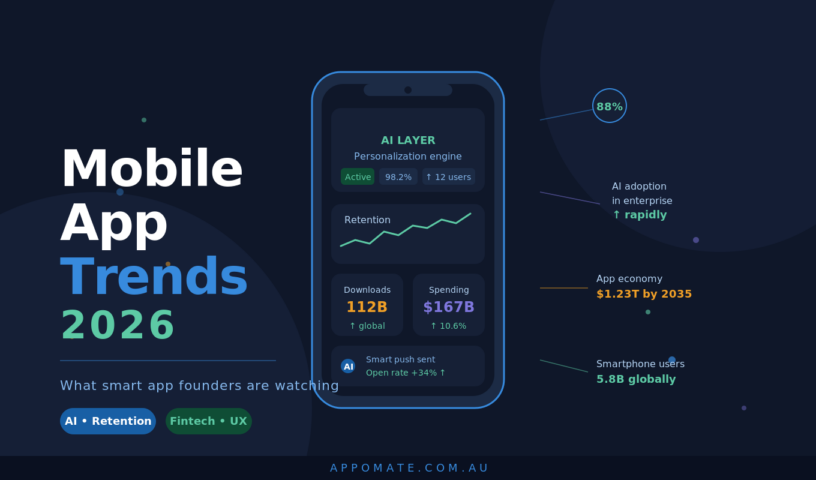
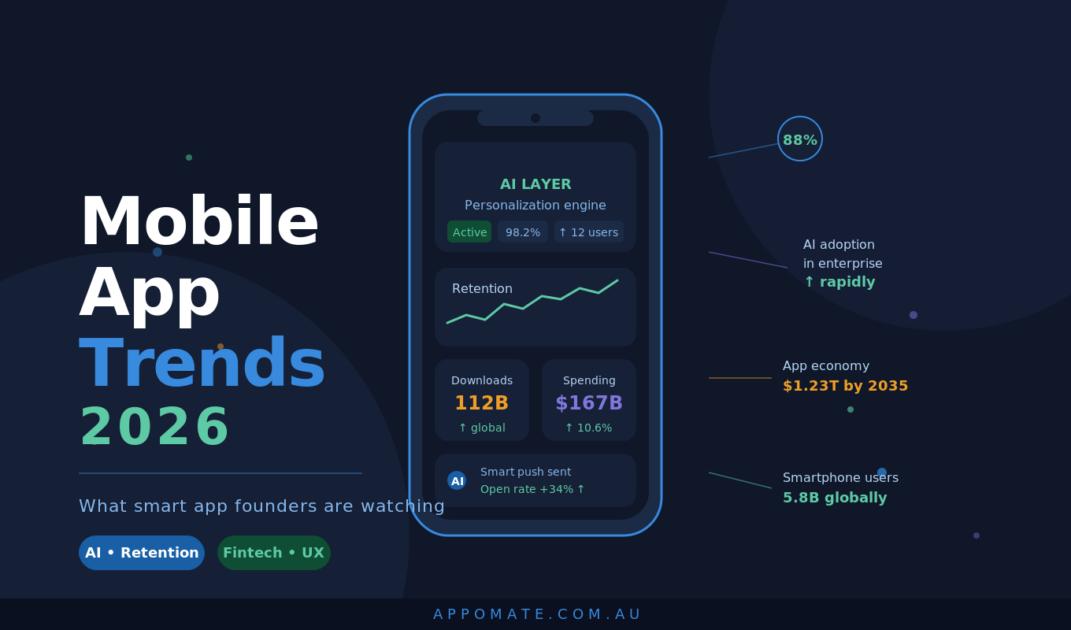
Global app downloads crossed 112.1 billion in 2025, while consumer spending increased 10.6% year-on-year to $167 billion. Around 5.8 billion people globally now use smartphones, and the app economy is projected to exceed $1.23 trillion by 2035.
On paper, these numbers look incredibly positive.
But underneath the growth, something more important is happening:
Users are becoming harder to keep.
Acquisition costs are changing. User journeys are moving across multiple devices. AI is reshaping customer expectations. And apps are increasingly competing not just against direct competitors — but against every other app fighting for user attention.
This is why the biggest mobile app trends in 2026 are no longer only about technology.
They are about:
- user behaviour
- retention economics
- smarter personalization
- quality acquisition
- and building apps that become part of daily life
The startups that understand this shift early will have a major advantage over the next few years.
 AI Is Becoming the Operating System Behind Modern Apps
One of the clearest shifts happening in 2026 is that AI is moving from “feature” to “foundation.”
A few years ago, many businesses treated AI like an add-on:
- a chatbot
- a recommendation engine
- an automation tool
- or a marketing experiment
That is changing rapidly.
Today, 88% of businesses report using AI in daily work, and adoption has accelerated dramatically since the launch of ChatGPT in late 2022.
But the most important insight is not the adoption number itself.
It is how AI is being operationalised.
The companies seeing real results are not using AI randomly. They are embedding it directly into workflows and decision-making systems.
The strongest use cases highlighted include:
- AI-powered data analysis
- predictive segmentation
- real-time personalization
- automated campaign optimisation
- dynamic user targeting
- creative testing
- customer journey modelling
Instead of waiting for marketing reports or manually analysing dashboards, teams can now use AI assistants to surface insights instantly and make decisions faster.
This is creating a huge shift in startup execution speed.
Smaller teams can now:
- test faster
- optimise faster
- personalise experiences faster
- and reduce operational overhead
But there is also an important reality many founders are still missing.
AI is improving execution speed.
It is not replacing strong product strategy.
Many apps are currently being rushed into the market with AI-generated workflows but weak:
- retention systems
- user psychology
- UX foundations
- onboarding flows
- scalability planning
- monetisation thinking
That is why some AI products get massive early attention but struggle to maintain long-term engagement.
The real opportunity in 2026 is not simply “using AI.”
It is combining AI efficiency with strong product thinking.
The Era of “Mobile-First” Is Ending
For nearly a decade, businesses focused on becoming mobile-first.
Now users are becoming platform-fluid.
A person may:
- discover a brand through social media
- research on desktop
- browse through mobile web
- click an email later
- and finally convert inside the app
This creates a major challenge for modern app businesses.
Only around 31% of marketers say they are fully satisfied with their ability to unify and understand data across platforms.
This matters more than many founders realise.
When attribution becomes fragmented:
- budgets become inefficient
- customer journeys become unclear
- and growth decisions become reactive instead of strategic
That is why cross-platform measurement, deep linking, and connected user experiences are becoming critical in 2026.
The smartest app businesses are no longer treating:
- websites
- apps
- ads
- emails
- landing pages
- social content
as separate systems.
They are building one connected ecosystem.
For founders, this is an important mindset shift.
Your app is no longer the product by itself.
The entire customer journey is the product.
The Real Battle in 2026 Is Retention, Not Acquisition
Global app installs increased 10% year-on-year in 2025, while sessions rose 7%.
At first glance, this suggests strong market growth.
But when you analyse the deeper behavioural patterns across gaming, e-commerce, and finance apps, a different story emerges.
The market is not struggling to attract users.
It is struggling to keep them engaged long enough to create meaningful lifetime value.
This is especially clear in gaming.
Gaming apps maintained:
- 27% day 1 retention
- 13% day 7 retention
- 5% day 30 retention
That means most users disappear quickly.
This explains why the entire app industry is becoming more focused on:
- engagement loops
- personalization
- behavioural design
- habit formation
- and long-term retention systems
The founders who continue obsessing only over downloads may struggle in the coming years.
Because installs are becoming easier to buy.
Retention is becoming harder to build.
Gaming Apps Reveal Where the Industry Is Heading
Gaming continues to act as one of the strongest behavioural indicators in the app industry.
In 2025:
- global mobile gamers reached nearly 3 billion
- representing over 80% of the global gaming population
- and eight of the top 10 mobile games each generated more than $1 billion in player spending
But the most interesting insight is not install volume.
It is how gaming companies are responding to rising acquisition costs.
Gaming CPI increased globally by 30%, reaching $0.56 in 2025.
This is forcing developers to rethink monetisation and retention strategies.
Hyper casual games historically focused on:
- rapid installs
- fast churn
- advertising-driven monetisation
But session growth patterns show that many are now adding stronger retention mechanics.
Hyper casual installs grew only 4%, while sessions increased 31%.
That gap matters.
It suggests developers are trying to extract more long-term engagement from existing users rather than simply chasing new installs.
Meanwhile, strategy games saw:
- 57% session growth
- and session lengths reaching 51 minutes
This is incredibly valuable attention time.
Gaming companies understand something many other startups still underestimate:
The longer users stay emotionally engaged, the more monetisable the product becomes.
This lesson applies far beyond gaming.
Every successful app category now borrows from behavioural psychology:
- streak systems
- reward loops
- progress tracking
- gamified engagement
- achievement systems
- social reinforcement
Apps are increasingly competing for habits, not just users.
E-Commerce Apps Are Becoming Faster and More Intent-Driven
The e-commerce sector is evolving in a fascinating way.
Global e-commerce app downloads increased from 4.36 billion in 2019 to 6.35 billion in 2025.
At the same time, the live commerce market is projected to approach $2.47 trillion by 2033.
But the most interesting behavioural trend is what is happening inside shopping apps.
Average e-commerce session lengths declined globally from 10.04 minutes to 9.6 minutes.
This may initially sound negative.
But shorter sessions are not always a bad sign.
In many cases, they reflect:
- faster purchasing decisions
- improved product discovery
- stronger recommendation systems
- reduced friction
- higher user intent
Modern users increasingly expect:
- convenience
- speed
- relevance
- and personalization
The apps winning in commerce are not necessarily the ones with the largest catalogues.
They are the ones reducing decision fatigue.
This is also where AI-driven commerce is becoming extremely important.
Shopping apps are increasingly using:
- AI product recommendations
- personalised feeds
- predictive discovery
- sizing assistants
- automated search experiences
to shorten the distance between discovery and purchase.
The result is fewer wasted interactions and faster conversion behaviour.
Finance Apps Are Becoming Daily Behavioural Infrastructure
Finance apps may be seeing the most powerful long-term behavioural shift of all.
The number of digital wallet users reached 4.5 billion globally in 2025, while the global neobanking market is projected to reach $13.67 trillion by 2031.
But the deeper insight is hidden in session behaviour.
Finance app installs declined 4% globally, yet sessions increased 21%.
This suggests something important:
Finance apps are becoming part of daily routines.
Users are not simply downloading these apps.
They are repeatedly returning to them for:
- payments
- transfers
- investing
- budgeting
- subscriptions
- banking
- digital wallets
That daily utility creates powerful retention economics.
It also explains why finance companies are becoming more aggressive with paid acquisition.
The global paid-to-organic ratio for finance apps increased to 1.13 in 2025.
LATAM emerged as one of the fastest-growing finance app regions:
- installs increased 76%
- sessions increased 57%
This reflects growing digital payment adoption globally.
The key lesson for founders is simple:
The strongest apps are not just useful.
They become behavioural infrastructure.
Paid Acquisition Is Becoming Smarter, Not Bigger
One of the strongest themes across the entire app ecosystem is the shift toward smarter acquisition.
Across gaming, e-commerce, and finance, businesses are becoming more selective about:
- where they spend
- who they target
- and what type of users they acquire
Gaming apps increased paid acquisition aggressively as competition intensified.
Finance apps also leaned more heavily into paid acquisition because CPI costs became cheaper across several regions.
At the same time, many app categories actually reduced the number of advertising partners they work with.
That tells us something very important.
Companies are moving away from:
“maximum scale”
toward:
“maximum efficiency.”
The focus is shifting toward:
- higher lifetime value users
- stronger retention quality
- better conversion behaviour
- more predictable ROI
This is a much more mature growth mindset than the aggressive scale-at-all-costs mentality seen in previous years.
The Future of Mobile Apps Is Becoming More Human
Ironically, as technology becomes more advanced, the winning apps are becoming more human-centered.
Users no longer care whether an app uses:
- AI
- machine learning
- automation
- predictive systems
What they care about is:
- convenience
- trust
- simplicity
- personalization
- emotional connection
- usefulness
The strongest apps in 2026 are not necessarily the most technically complicated.
They are the ones that:
- understand user behaviour deeply
- reduce friction
- create habits
- and fit naturally into everyday life
That is the deeper story behind mobile app trends in 2026.
The future belongs to apps that feel essential.
Final Thoughts
The mobile app industry is entering a more mature phase.
AI is becoming operational infrastructure. User journeys are becoming fragmented across platforms. Retention is becoming more valuable than raw installs. Paid acquisition is becoming more selective. And user expectations are rising rapidly.
But despite the complexity, the opportunity remains enormous.
The startups most likely to succeed over the next few years will not simply build more features.
They will:
- build better experiences
- create stronger habits
- personalise intelligently
- understand retention deeply
- and focus on meaningful user value
Because in 2026, the apps that survive will not just be downloaded.
They will be the ones users genuinely return to.
Looking to Build an App in 2026?
At Appomate, we help startup founders validate, prototype and launch scalable mobile apps faster through:
- rapid prototyping
- MVP development
- AI-assisted workflows
- UX strategy
- scalable app development
Whether you are building a fintech platform, AI startup, marketplace app, wellness app or SaaS product, our team can help you reduce risk and move from idea to launch faster.
Book a discovery session with Appomate to explore your app idea.