App security has always been important in digital products, but the world of app development in 2026 looks noticeably different from just a year or two ago. App security risks 2026 must be considered as threats are evolving faster, becoming more automated, and often harder to detect. Attackers are finding new ways to exploit the frameworks and tools modern apps rely on, and security incidents now unfold at a speed that many businesses struggle to respond to.
For founders and business owners building mobile or web apps, this shift changes everything.
App security can no longer sit quietly behind the scenes. It has become part of the product experience itself. If your app handles user data, payments, personal information, or AI-powered features, security is now directly linked to trust, growth, and reputation.
In this blog, we break down the biggest app security risks in 2026, why they matter, and what founders can do right now to protect their users and build stronger digital products.
The Security Shift in 2026
Why App Security Looks Different This Year
Modern apps are built with more moving parts than ever. A single product may rely on dozens of open-source libraries, third-party SDKs, authentication providers, cloud services, payment gateways, analytics tools, and increasingly, AI models.
This creates massive opportunity for innovation and speed.
But it also introduces a major risk: one weak link can compromise the entire system.
Security used to be mostly about protecting servers and databases. In 2026, it’s about securing a complex network of dependencies, integrations, and automated workflows.
Attackers are taking advantage of this complexity. With automated scanning tools, they can probe thousands of apps at once. With AI, they can generate and refine attacks faster than most human teams can react.
The result is a threat environment that feels more relentless than ever before — and it’s why founders can no longer treat security as an afterthought.
The Spike in React, Next.js and Vercel Vulnerabilities
One of the most noticeable trends in late 2025 and early 2026 has been the growing number of incidents linked to frameworks like React and Next.js, and deployment environments such as Vercel.
These technologies power a huge portion of the modern web, and their popularity makes them high-value targets.
Many of the recent incidents have been caused by:
-
insecure build configurations
-
exposed environment variables
-
vulnerable npm packages
-
misconfigured deployments
-
outdated dependencies
-
rushed releases without security review
The challenge is that the ecosystem evolves quickly. Updates ship constantly, and teams often adopt them without fully understanding the security impact. Attackers take advantage of this speed and exploit small missteps in configuration or dependency management.
For founders, this is an important reminder: choosing modern frameworks is powerful, but keeping them secure requires proactive monitoring and disciplined deployment standards.
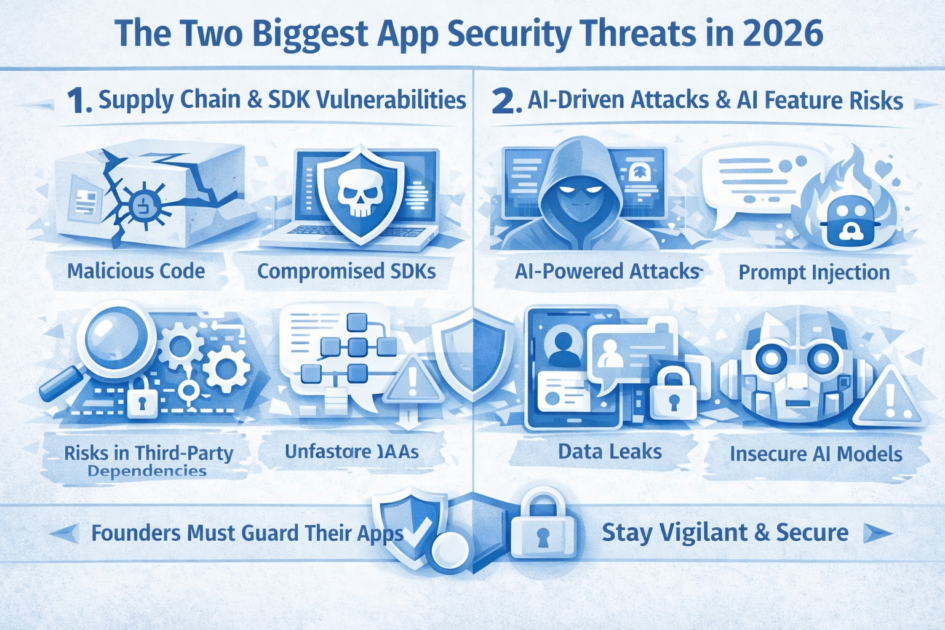
The Two Biggest App Security Threats in 2026
1. Supply Chain and SDK Vulnerabilities
Supply chain vulnerabilities are now one of the biggest security risks in modern software.
Most apps today rely heavily on third-party libraries, plugins, SDKs, and open-source tools. While these accelerate development, they also introduce a major risk: if one dependency is compromised, it can create a direct path into your production environment.
Common supply chain threats include:
-
malware injected into open-source packages
-
compromised vendor SDK updates
-
hidden tracking or data leakage through third-party tools
-
vulnerabilities deep within dependency trees
-
packages that are “safe” today but become unsafe tomorrow
The scary part is that these issues often exist far away from the code your team actually writes. Many businesses believe their app is secure because their own codebase looks clean — while a third-party update may have introduced a vulnerability months earlier.
To reduce this risk, founders should prioritise:
-
dependency scanning tools
-
software composition analysis (SCA)
-
strict governance around which SDKs are approved
-
build verification and integrity checks in CI/CD
-
controlled update processes (not blind auto-updates)
In 2026, supply chain security isn’t optional. It’s foundational.
2. AI-Driven Attacks and AI Feature Risks
AI has transformed app development, but it has also transformed cybercrime.
Attackers now use AI to:
-
automate credential stuffing
-
simulate human user behaviour
-
craft convincing phishing and social engineering attempts
-
generate and refine exploit attempts rapidly
-
identify patterns in security weaknesses faster than manual methods
At the same time, apps that include AI features are creating new vulnerabilities of their own.
Common AI-related security risks include:
-
prompt injection attacks
-
unprotected model endpoints
-
leaking sensitive user information through AI inputs
-
insecure storage of AI conversation logs
-
AI outputs being trusted without validation
-
poor permission control around AI workflows
Many founders add AI quickly to keep up with the market, without fully considering how those models interact with sensitive data or how they could be manipulated.
If AI drives any part of your product experience, it must be treated as a high-risk component. Secure AI architecture should include controlled orchestration layers, input validation, output filtering, and proper access controls.
AI can be a competitive advantage — but only if it’s implemented responsibly.
Other Rising App Security Risks to Watch in 2026
API Weaknesses and Overexposed Endpoints
APIs are essential for modern apps. They connect mobile apps to databases, enable user authentication, handle payments, and power integrations.
But APIs also create one of the largest attack surfaces in app development.
Common API security issues include:
-
weak authentication and authorisation
-
endpoints exposing too much data
-
excessive permissions granted to users
-
lack of rate limiting
-
predictable object IDs leading to data leaks
-
business logic vulnerabilities
These weaknesses can lead to mass scraping, unauthorised access, and serious data exposure.
To reduce API risk, founders should adopt:
-
zero trust API design
-
strict access control rules
-
minimal data exposure principles
-
monitoring and anomaly detection
-
endpoint testing as part of regular release cycles
API security is one of the most critical priorities for any app handling sensitive user data.
Outdated or Weak Authentication Flows
Old authentication methods are becoming less reliable every year. Password-only logins, weak password policies, and SMS-based authentication can no longer keep up with modern threats.
Credential stuffing and account takeover attacks are increasing because attackers can buy leaked credentials cheaply and test them at scale.
In 2026, modern apps are shifting toward:
-
passkeys
-
biometric authentication
-
device-based identity verification
-
multi-factor authentication using stronger methods
For founders, improving authentication isn’t just about security — it’s about credibility. Users expect modern protection.
Insecure Data Storage on the Device
Mobile apps often store sensitive information on the device, such as:
-
authentication tokens
-
personal user details
-
cached data
-
business logic and configuration
If this data is stored insecurely, attackers can reverse engineer the app or extract information if a device is compromised.
Common mistakes include:
-
storing tokens in local storage without encryption
-
caching sensitive data unnecessarily
-
failing to use secure enclaves or keychains
-
exposing internal logic that can be exploited
Best practice is simple: sensitive data should be encrypted and stored using native secure storage methods, and apps should avoid storing unnecessary information on the client side.
Session Management and Token Handling Issues
Session handling is one of the most overlooked security risks in apps — because everything appears to work normally until it fails.
Poor session management can result in:
-
long-lived access tokens
-
weak refresh token strategies
-
inconsistent logout behaviour
-
sessions staying active after password changes
-
stolen tokens being reused without detection
Secure apps need strong session lifecycle management, including:
-
short-lived access tokens
-
refresh token rotation
-
revocation frameworks
-
logout and device de-authorisation systems
For founders, secure sessions protect both users and the business.
What This Means for Founders Building Apps in 2026
If you’re building an app in 2026 — whether it’s your first startup or a new digital product for your business — security is no longer something you “add later.”
It’s not just a technical checkbox.
It’s a business decision.
Today’s users are more aware of data privacy. Investors ask about infrastructure. Enterprise clients review security practices before signing contracts. And one public breach can undo years of trust.
For founders, this changes the game.
Security now affects:
-
User trust and retention
-
Investor confidence
-
Growth velocity
-
Compliance and legal exposure
-
Brand reputation
The hard truth is this: you can build the most beautifully designed app in your category — but if it leaks user data or suffers a preventable attack, growth stops immediately.
Why This Matters for Early-Stage Founders
Many founders assume security is something to worry about “after scale.”
But 2026’s threat landscape doesn’t work like that.
Attacks are automated. Bots scan thousands of apps daily. Small startups are targeted just as often as big brands — sometimes more, because attackers assume weaker defences.
And early-stage apps often rely heavily on third-party SDKs, rapid iteration, and quick AI integrations — which increases exposure if security is not handled carefully.
Security isn’t about fear.
It’s about protecting momentum.
The Smart Founder’s Approach to Security in 2026
If you’re launching or scaling an app, here’s what matters most:
1. Start with secure architecture
Choose infrastructure and systems designed for scale and protection, not just speed.
2. Audit dependencies before you ship
Open-source packages and SDKs should be reviewed, monitored, and governed.
3. Upgrade authentication
Passkeys, strong MFA, and modern login standards should be built into the roadmap.
4. Encrypt data on device and in transit
User trust depends on it — especially in finance, healthcare, and personal data apps.
5. Treat AI features as security-critical
AI features must be protected against prompt injection, misuse, and data leakage.
Security Is a Growth Strategy, Not a Cost
Founders who win in 2026 aren’t only building faster — they’re building smarter.
Strong security:
-
strengthens user trust
-
reduces churn
-
improves investor readiness
-
prevents expensive rebuilds
-
avoids brand damage
It is easier and cheaper to build securely from the start than to recover from a security breach later.
Looking Ahead: Building Secure Apps That Scale
The best security starts with understanding how data moves through your app — where it’s stored, how it’s transferred, and which third-party services touch it.
From there, the best path forward includes:
-
stronger authentication systems
-
hardened APIs
-
secure device storage
-
dependency monitoring
-
automated security checks in development pipelines
-
ongoing monitoring and incident response plans
Security is not something you “finish.” It’s something you maintain continuously as your product evolves.
The businesses that invest in security early will protect users, maintain trust, and grow with confidence in a world where threats aren’t slowing down.
Final Thoughts
The security landscape has shifted dramatically, and 2026 is proving to be a defining year for digital products.
The biggest risks are no longer limited to simple vulnerabilities — they now include supply chain attacks, AI-driven threats, exposed APIs, weak authentication, and insecure app storage.
If you’re building a mobile or web app today, security isn’t just about protecting your code.
It’s about protecting your customers, your brand, and your future growth.
Because in 2026, trust is the product.