The mobile app industry is on track to reach USD 391.3 billion in 2026.
That number sounds exciting — but for founders, CTOs, and product leaders, the bigger story is tougher:
The market has moved from “download-first” to “retention-first.”
People spend most of their digital life on phones. Many apps still get removed fast — with uninstall benchmarks around 46% within 30 days (Android).
So, if your plan is “launch → run ads → celebrate downloads,” you’re playing the 2026 game with 2016 rules.
This guide gives you a 360° view of the mobile app industry in 2026 — and what the stats mean for product, growth, and engineering decisions.
Key takeaways (2026 snapshot)
- USD 391.3B global mobile application market size in 2026
- 46% of installs uninstalled within 30 days (Android benchmarks)
- Mobile continues to set record highs across downloads, revenue and time spent, with Generative AI as a key driver
1) Global Mobile App Market Overview: Where the Industry Stands
The global mobile application market is expected to grow from USD 333.93B (2025) to USD 391.3B (2026), and reach USD 864.5B by 2031.
That is not “nice growth.” That is a structural shift. Mobile is where customers discover, decide, pay, and stay loyal.
Chart: Global Mobile Application Market Size (USD billions)
What this means for leaders:
If your mobile product still feels like a “smaller website,” you will lose to apps designed for fast value, personalisation, and repeat engagement.
The Australian Mobile App Market: A Growing Digital Economy
While global mobile app statistics show rapid growth, the Australian mobile app market is also expanding steadily and contributing significantly to the global app economy.
Australia has one of the highest smartphone penetration rates in the world, with over 90% of Australians using smartphones. This strong mobile adoption has translated into consistent app usage, downloads, and revenue generation across both the Apple App Store and Google Play.
Recent industry estimates suggest that Australians generate billions of mobile app downloads each year, with the majority coming from entertainment, social media, finance, shopping, and productivity apps. In terms of revenue, the Australian mobile app market produces several billion dollars annually through app purchases, subscriptions, and in-app purchases.
Compared with other regions, Australia is considered a high-value mobile app market. While countries like India or Indonesia may generate higher download volumes, Australia often delivers higher average revenue per user (ARPU) due to strong purchasing power and high adoption of subscription-based apps.
For founders and product teams, this means that building mobile apps with strong user experience, retention strategies, and subscription models can perform particularly well in the Australian market.
2) Mobile App Revenue: The Retention Economy
Revenue has moved away from paid downloads and into subscriptions + in-app purchases + recurring monetisation loops.
Sensor Tower’s State of Mobile 2026 report highlights that the market hit record highs across key metrics, with AI helping drive new consumer behaviour.
What this means:
Your app’s business model must match retention. If users do not return, subscriptions fail, IAP stalls, and CAC becomes unrecoverable.
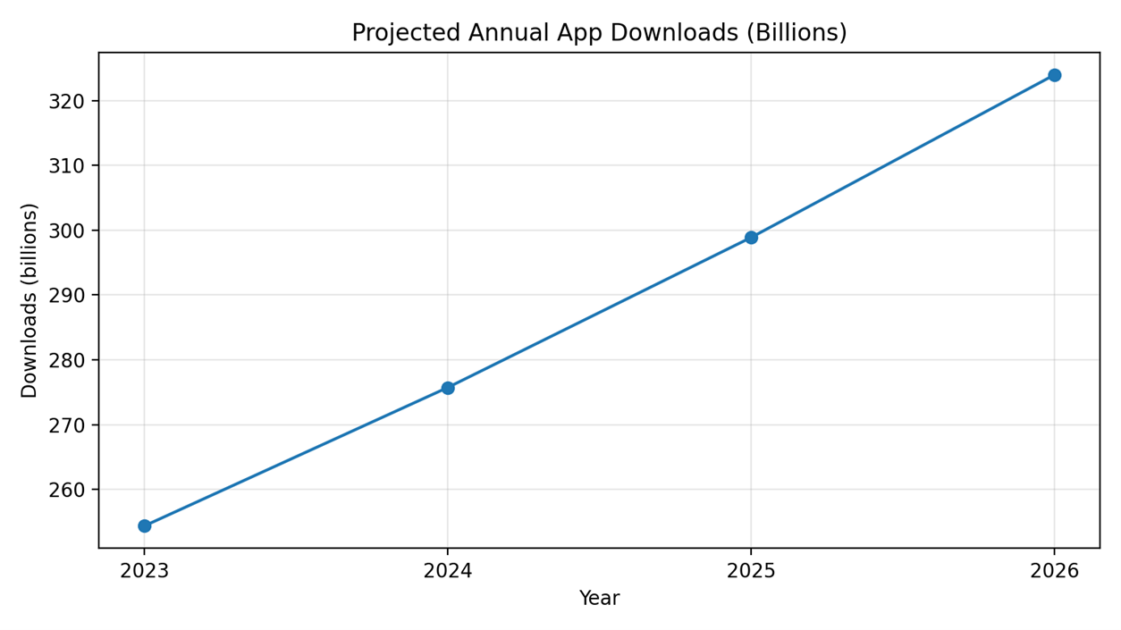
3) Downloads: High Volume, Higher Competition
Downloads remain massive — but users have become pickier.
In practical terms, many markets now face app fatigue: people download, test quickly, and delete fast if they don’t see value.
What this means for product:
You must reduce “time to value.” The first session needs to show the core benefit quickly, without friction.
Chart: Projected annual app downloads (based on 8.4% CAGR to 2026)
4) Time Spent: The Trillion-Hour Attention Battle
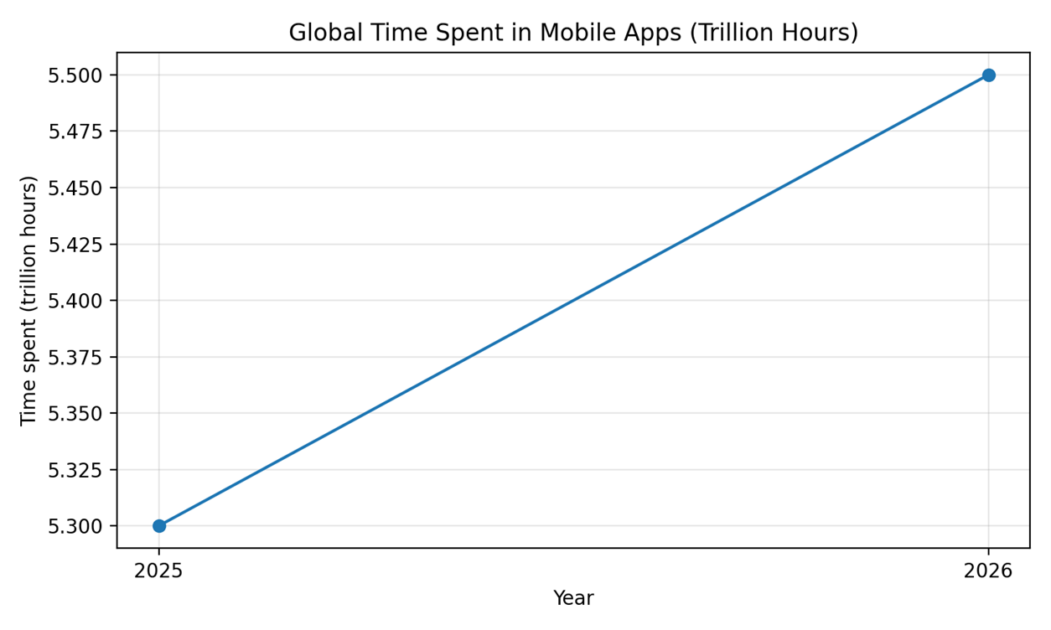
Mobile attention keeps climbing. Sensor Tower’s reporting shows time spent keeps growing, and “AI + entertainment formats” are major drivers.
What this means for engineering:
Performance and reliability become retention features. Slow screens, crashes, and battery drain now directly impact churn.
5) Retention & Uninstalls: Why Apps Lose Users in 2026
Uninstall benchmarks remain harsh. AppsFlyer’s uninstall benchmarks show uninstall rates around 46% within 30 days (noting iOS tracking limits post-iOS 15).
Why users leave (common 2026 patterns):
- They hit a sign-up wall before seeing value
- The onboarding feels confusing
- The app asks for too many permissions too soon
- It loads slowly, drains battery, or feels buggy
What this means for product teams:
Retention is not a marketing problem. It’s a design + performance + lifecycle problem.
6) Generative AI on Mobile: The 2026 Force Multiplier
Generative AI is now reshaping the app economy. Sensor Tower’s State of Mobile 2026 notes that AI is driving record highs across downloads and usage.
What this means:
AI features alone won’t save retention. The winners will be apps that:
- integrate AI into real workflows
- keep UX simple
- deliver consistent value after the novelty fades
7) iOS vs Android: Reach vs Revenue
Your platform strategy is no longer “build both later.” It’s a business decision tied to:
- spending power
- device diversity
- rollout speed
- monetisation model
If you sell subscriptions, premium UX, and high LTV — iOS often becomes your fastest path.
If you need reach and scale — Android and emerging markets matter more.
8) Business Impact: A Blueprint for 2026 App Success
If you’re building in 2026, prioritise:
- Speed to Value (TTV) — show the core benefit fast
- Retention loops — habits, reminders, saved state, re-entry points
- Performance — fast load, stable sessions, smooth onboarding
- Privacy-first trust — explain permissions clearly and early
- AI-native experiences — but only where it reduces effort for users
Ready to build your app? Contact us today to schedule your free discovery call.
FAQs
1) How much will the mobile app market be worth in 2026?
Mordor Intelligence forecasts USD 391.3 billion in 2026.
2) Why is retention the main challenge in 2026?
Because uninstall benchmarks show around 46% of installs are uninstalled within 30 days (Android).
3) What is driving mobile growth right now?
Sensor Tower’s State of Mobile 2026 highlights Generative AI as a key driver across record highs in downloads, revenue, and time spent.
4)Which app categories are growing fastest in 2026?
Generative AI-powered apps, health & fitness, and fintech,
5)How is Generative AI changing user expectations for apps?
Users are increasingly expecting apps to feel “intelligent” personalising content, anticipating needs, and reducing manual input. Apps that integrate AI to genuinely simplify workflows are seeing stronger retention, while those that bolt on AI as a marketing feature without UX benefit are not seeing the same lift.